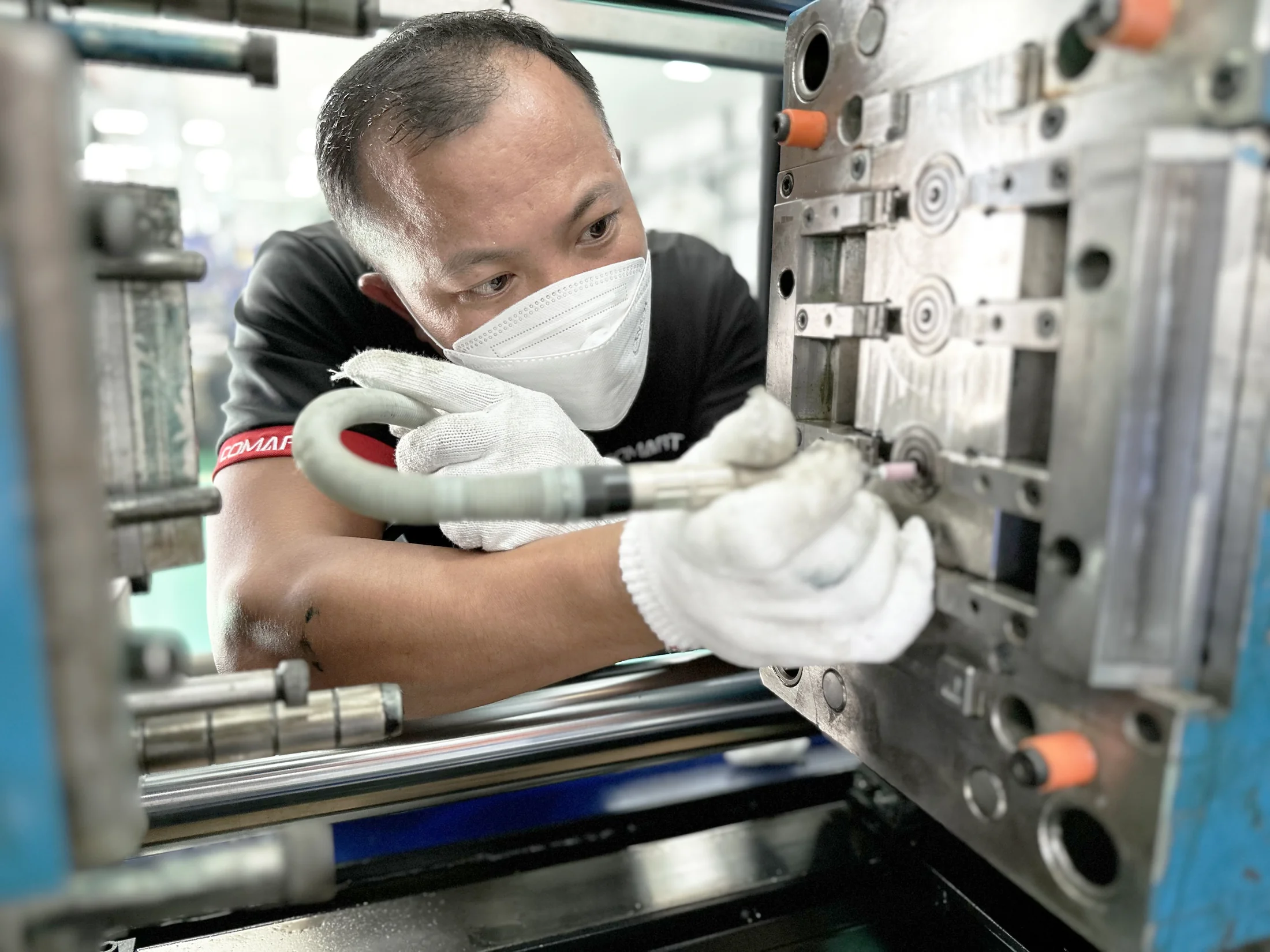
The stage where a phone holder stops being a design and becomes a steel tool — and where changes stop being cheap.
We build prototypes to answer specific questions, not to produce a nice-looking sample. An appearance model validates form and finish. A functional model validates the mechanism — whether a clamp holds a large phone on a rough road, whether a hinge survives its cycle count, whether a stand tips when you tap the screen.
DFM review happens before mold design, not after T1. On a car mount that usually means arguing about draft on a visible face, where the parting line falls on a curved housing, and whether a snap fit can be molded without a side action that adds cost to every shot for the life of the tool.
Mold design, flow, parting, gating and ejection are planned as one decision set, because changing one of them later changes all of them. A gate moved to fix a cosmetic defect can put a weld line somewhere structural.
More than 318 proprietary molds are running in our plants. Mold design, trial, revision and acceptance stay under our own process control rather than being subcontracted and re-quoted.
Send us the design and we will tell you what will fight the tool — while it is still a drawing revision rather than a tool modification.
